MakazhanAlpamys/SoupPublic

Fine-tune LLMs from one YAML. Layer streaming trains an 8B model on a 4 GB laptop GPU.

AI summary: A lightning-fast, C++ based LLM fine-tuning CLI that utilizes layer streaming.

Stars
8.1K
+186 today
Forks
1.3K
Watchers
51
Open issues
128
Open PRs
81
Contributors
~95
Commits
1.6K
Branches
51

PythonApache-2.0Created Feb 20, 2026Last push 2d agoLatest release v0.75.2+663 stars this week+2.8K this month

Quick answers

What is Soup?
A lightning-fast, C++ based LLM fine-tuning CLI that utilizes layer streaming.
What does Soup do?
Soup is a highly optimized Command Line Interface tool designed for fine-tuning Large Language Models on consumer-grade hardware. It achieves remarkable efficiency by utilizing a C++ backend and a novel technique called 'layer streaming', which significantly reduces the VRAM required to train massive models. The tool is designed to provide an incredibly fast, lightweight alternative to heavy Python-based training frameworks, making it possible to run sophisticated parameter-efficient fine-tuning (PEFT) on standard desktop GPUs. It strips away complex dependencies to focus entirely on raw execution speed and memory optimization.
Who is Soup for?
This tool is intended for machine learning engineers, AI researchers, and developers who need to fine-tune LLMs but are restricted by consumer hardware. Users should have a strong understanding of command-line tools and LLM training concepts.
How do I get started with Soup?
git clone https://github.com/MakazhanAlpamys/Soup.git
How popular is Soup on GitHub?
MakazhanAlpamys/Soup has 8,070 stars and 1,298 forks on GitHub, and gained 663 stars in the last 7 days.
What license does Soup use?
MakazhanAlpamys/Soup is released under the Apache-2.0 license.

Star history

since Aug 16, 2026
02.5K5K7.5KAug 2026Sep 2026Sep 2026Oct 2026
8.1K stars as of Oct 4, 2026. Measured daily since Aug 16, 2026; GitHub no longer exposes earlier star timestamps.

Contribution activity

commits per day, last 52 weeks
OctNovDecJanFebMarAprMayJunJulAugSepMonWedFri2025-10-04: 0 commits2025-10-05: 0 commits2025-10-06: 0 commits2025-10-07: 0 commits2025-10-08: 0 commits2025-10-09: 0 commits2025-10-10: 0 commits2025-10-11: 0 commits2025-10-12: 0 commits2025-10-13: 0 commits2025-10-14: 0 commits2025-10-15: 0 commits2025-10-16: 0 commits2025-10-17: 0 commits2025-10-18: 0 commits2025-10-19: 0 commits2025-10-20: 0 commits2025-10-21: 0 commits2025-10-22: 0 commits2025-10-23: 0 commits2025-10-24: 0 commits2025-10-25: 0 commits2025-10-26: 0 commits2025-10-27: 0 commits2025-10-28: 0 commits2025-10-29: 0 commits2025-10-30: 0 commits2025-10-31: 0 commits2025-11-01: 0 commits2025-11-02: 0 commits2025-11-03: 0 commits2025-11-04: 0 commits2025-11-05: 0 commits2025-11-06: 0 commits2025-11-07: 0 commits2025-11-09: 0 commits2025-11-10: 0 commits2025-11-11: 0 commits2025-11-12: 0 commits2025-11-13: 0 commits2025-11-14: 0 commits2025-11-15: 0 commits2025-11-16: 0 commits2025-11-17: 0 commits2025-11-18: 0 commits2025-11-19: 0 commits2025-11-20: 0 commits2025-11-21: 0 commits2025-11-22: 0 commits2025-11-23: 0 commits2025-11-24: 0 commits2025-11-25: 0 commits2025-11-26: 0 commits2025-11-27: 0 commits2025-11-28: 0 commits2025-11-29: 0 commits2025-11-30: 0 commits2025-12-01: 0 commits2025-12-02: 0 commits2025-12-03: 0 commits2025-12-04: 0 commits2025-12-05: 0 commits2025-12-06: 0 commits2025-12-07: 0 commits2025-12-08: 0 commits2025-12-09: 0 commits2025-12-10: 0 commits2025-12-11: 0 commits2025-12-12: 0 commits2025-12-13: 0 commits2025-12-14: 0 commits2025-12-15: 0 commits2025-12-16: 0 commits2025-12-17: 0 commits2025-12-18: 0 commits2025-12-19: 0 commits2025-12-20: 0 commits2025-12-21: 0 commits2025-12-22: 0 commits2025-12-23: 0 commits2025-12-24: 0 commits2025-12-25: 0 commits2025-12-26: 0 commits2025-12-27: 0 commits2025-12-28: 0 commits2025-12-29: 0 commits2025-12-30: 0 commits2025-12-31: 0 commits2026-01-01: 0 commits2026-01-02: 0 commits2026-01-03: 0 commits2026-01-04: 0 commits2026-01-05: 0 commits2026-01-06: 0 commits2026-01-07: 0 commits2026-01-08: 0 commits2026-01-09: 0 commits2026-01-10: 0 commits2026-01-11: 0 commits2026-01-12: 0 commits2026-01-13: 0 commits2026-01-14: 0 commits2026-01-15: 0 commits2026-01-16: 0 commits2026-01-17: 0 commits2026-01-18: 0 commits2026-01-19: 0 commits2026-01-20: 0 commits2026-01-21: 0 commits2026-01-22: 0 commits2026-01-23: 0 commits2026-01-24: 0 commits2026-01-25: 0 commits2026-01-26: 0 commits2026-01-27: 0 commits2026-01-28: 0 commits2026-01-29: 0 commits2026-01-30: 0 commits2026-01-31: 0 commits2026-02-01: 0 commits2026-02-02: 0 commits2026-02-03: 0 commits2026-02-04: 0 commits2026-02-05: 0 commits2026-02-06: 0 commits2026-02-07: 0 commits2026-02-08: 0 commits2026-02-09: 0 commits2026-02-10: 0 commits2026-02-11: 0 commits2026-02-12: 0 commits2026-02-13: 0 commits2026-02-14: 0 commits2026-02-15: 0 commits2026-02-16: 0 commits2026-02-17: 0 commits2026-02-18: 0 commits2026-02-19: 0 commits2026-02-20: 5 commits2026-02-21: 0 commits2026-02-22: 0 commits2026-02-23: 3 commits2026-02-24: 1 commit2026-02-25: 0 commits2026-02-26: 0 commits2026-02-27: 0 commits2026-02-28: 0 commits2026-03-01: 0 commits2026-03-02: 5 commits2026-03-03: 3 commits2026-03-04: 2 commits2026-03-05: 10 commits2026-03-06: 0 commits2026-03-07: 0 commits2026-03-08: 0 commits2026-03-09: 0 commits2026-03-10: 0 commits2026-03-11: 0 commits2026-03-12: 0 commits2026-03-13: 0 commits2026-03-14: 0 commits2026-03-15: 0 commits2026-03-16: 0 commits2026-03-17: 0 commits2026-03-18: 0 commits2026-03-19: 0 commits2026-03-20: 0 commits2026-03-21: 0 commits2026-03-22: 0 commits2026-03-23: 29 commits2026-03-24: 20 commits2026-03-25: 26 commits2026-03-26: 20 commits2026-03-27: 0 commits2026-03-28: 0 commits2026-03-29: 0 commits2026-03-30: 0 commits2026-03-31: 0 commits2026-04-01: 24 commits2026-04-02: 3 commits2026-04-03: 10 commits2026-04-04: 3 commits2026-04-05: 2 commits2026-04-06: 1 commit2026-04-07: 6 commits2026-04-08: 0 commits2026-04-09: 0 commits2026-04-10: 2 commits2026-04-11: 0 commits2026-04-12: 0 commits2026-04-13: 5 commits2026-04-14: 0 commits2026-04-15: 2 commits2026-04-16: 0 commits2026-04-17: 0 commits2026-04-18: 0 commits2026-04-19: 4 commits2026-04-20: 5 commits2026-04-21: 3 commits2026-04-22: 3 commits2026-04-23: 3 commits2026-04-24: 3 commits2026-04-25: 2 commits2026-04-26: 2 commits2026-04-27: 13 commits2026-04-28: 5 commits2026-04-29: 0 commits2026-04-30: 3 commits2026-05-01: 4 commits2026-05-02: 0 commits2026-05-03: 2 commits2026-05-04: 1 commit2026-05-05: 0 commits2026-05-06: 0 commits2026-05-07: 0 commits2026-05-08: 7 commits2026-05-09: 8 commits2026-05-10: 6 commits2026-05-11: 8 commits2026-05-12: 5 commits2026-05-13: 14 commits2026-05-14: 9 commits2026-05-15: 12 commits2026-05-16: 0 commits2026-05-17: 2 commits2026-05-18: 4 commits2026-05-19: 5 commits2026-05-20: 6 commits2026-05-21: 2 commits2026-05-22: 1 commit2026-05-23: 0 commits2026-05-24: 4 commits2026-05-25: 4 commits2026-05-26: 3 commits2026-05-27: 1 commit2026-05-28: 0 commits2026-05-29: 0 commits2026-05-30: 1 commit2026-05-31: 3 commits2026-06-01: 11 commits2026-06-02: 5 commits2026-06-03: 9 commits2026-06-04: 9 commits2026-06-05: 3 commits2026-06-06: 4 commits2026-06-07: 5 commits2026-06-08: 3 commits2026-06-09: 3 commits2026-06-10: 6 commits2026-06-11: 0 commits2026-06-12: 1 commit2026-06-13: 0 commits2026-06-14: 0 commits2026-06-15: 0 commits2026-06-16: 0 commits2026-06-17: 0 commits2026-06-18: 0 commits2026-06-19: 0 commits2026-06-20: 3 commits2026-06-21: 1 commit2026-06-22: 3 commits2026-06-23: 0 commits2026-06-24: 0 commits2026-06-25: 0 commits2026-06-26: 0 commits2026-06-27: 1 commit2026-06-28: 3 commits2026-06-29: 0 commits2026-06-30: 0 commits2026-07-01: 8 commits2026-07-02: 6 commits2026-07-03: 3 commits2026-07-04: 16 commits2026-07-05: 40 commits2026-07-06: 17 commits2026-07-07: 5 commits2026-07-08: 3 commits2026-07-09: 0 commits2026-07-10: 0 commits2026-07-11: 0 commits2026-07-12: 9 commits2026-07-13: 3 commits2026-07-14: 0 commits2026-07-15: 15 commits2026-07-16: 21 commits2026-07-17: 8 commits2026-07-18: 0 commits2026-07-19: 8 commits2026-07-20: 0 commits2026-07-21: 0 commits2026-07-22: 0 commits2026-07-23: 0 commits2026-07-24: 0 commits2026-07-25: 0 commits2026-07-26: 1 commit2026-07-27: 3 commits2026-07-28: 9 commits2026-07-29: 1 commit2026-07-30: 0 commits2026-07-31: 1 commit2026-08-01: 5 commits2026-08-02: 0 commits2026-08-03: 9 commits2026-08-04: 3 commits2026-08-05: 12 commits2026-08-06: 25 commits2026-08-07: 39 commits2026-08-08: 23 commits2026-08-09: 23 commits2026-08-10: 1 commit2026-08-11: 9 commits2026-08-12: 3 commits2026-08-13: 13 commits2026-08-14: 15 commits2026-08-15: 14 commits2026-08-16: 16 commits2026-08-17: 11 commits2026-08-18: 17 commits2026-08-19: 12 commits2026-08-20: 15 commits2026-08-21: 9 commits2026-08-22: 15 commits2026-08-23: 20 commits2026-08-24: 21 commits2026-08-25: 12 commits2026-08-26: 10 commits2026-08-27: 18 commits2026-08-28: 14 commits2026-08-29: 6 commits2026-08-30: 4 commits2026-08-31: 21 commits2026-09-01: 16 commits2026-09-02: 20 commits2026-09-03: 19 commits2026-09-04: 12 commits2026-09-05: 21 commits2026-09-06: 20 commits2026-09-07: 14 commits2026-09-08: 4 commits2026-09-09: 14 commits2026-09-10: 10 commits2026-09-11: 17 commits2026-09-12: 22 commits2026-09-13: 28 commits2026-09-14: 48 commits2026-09-15: 33 commits2026-09-16: 8 commits2026-09-17: 25 commits2026-09-18: 25 commits2026-09-19: 16 commits2026-09-20: 0 commits2026-09-21: 15 commits2026-09-22: 24 commits2026-09-23: 7 commits2026-09-24: 22 commits2026-09-25: 23 commits2026-09-26: 9 commits2026-09-27: 34 commits2026-09-28: 35 commits2026-09-29: 18 commits2026-09-30: 30 commits2026-10-01: 34 commits2026-10-02: 8 commits2026-10-03: 0 commits
1,633 commits in the last yearLessMore

Signals and awards

derived from tracked data
  • Rising fast

    +663 stars this week

  • Very active

    1,633 commits in 52 weeks

  • Well documented

    High community health score

  • Permissive license

    Apache-2.0

  • Continuous integration

    Automated checks passing

  • Repeat trending

    8 trending appearances

What Soup does

Soup is a highly optimized Command Line Interface tool designed for fine-tuning Large Language Models on consumer-grade hardware. It achieves remarkable efficiency by utilizing a C++ backend and a novel technique called 'layer streaming', which significantly reduces the VRAM required to train massive models. The tool is designed to provide an incredibly fast, lightweight alternative to heavy Python-based training frameworks, making it possible to run sophisticated parameter-efficient fine-tuning (PEFT) on standard desktop GPUs. It strips away complex dependencies to focus entirely on raw execution speed and memory optimization.

This tool is intended for machine learning engineers, AI researchers, and developers who need to fine-tune LLMs but are restricted by consumer hardware. Users should have a strong understanding of command-line tools and LLM training concepts.

  • Layer Streaming Architecture: Streams model layers on demand to drastically minimize the continuous VRAM footprint during training.
  • C++ Optimization: Built entirely in C++ to strip out Python overhead and maximize raw computational performance.
  • Hardware Accessibility: Enables parameter-efficient fine-tuning of massive LLMs on standard, consumer-grade desktop GPUs.
  • CLI Driven: Provides a lean, highly focused command-line interface without the bloat of massive training platforms.
  • Lightweight Footprint: Achieves lightning-fast startup and execution times by aggressively minimizing external dependencies.

Where teams use it

Consumer Hardware Fine-Tuning

AI hobbyists and independent developers use the tool to fine-tune large language models directly on their personal gaming PCs.

Rapid Model Experimentation

Researchers deploy the lightweight CLI to quickly iterate on experimental fine-tuning runs without renting expensive cloud clusters.

Memory Constrained Training

Machine learning engineers leverage the layer streaming architecture to train models that would normally exceed their available VRAM.

High-Speed Execution

Developers frustrated with the overhead of Python frameworks utilize the C++ core for maximum raw training throughput.

Getting started: git clone https://github.com/MakazhanAlpamys/Soup.git

README

main branch

🌍 English | Türkçe | العربية | 日本語

Soup

Soup

Fine-tune and post-train LLMs in one command. No SSH, no config hell.

Website · Quick Start · Web UI · Config · Docs · Commands · Models · Discord · Telegram · Product Hunt

PyPI Downloads Python 3.10-3.12 Apache-2.0 License Tests CI Website Discord Telegram DOI: 10.5281/zenodo.21771064

Soup CLI - Fine-tune an 8B LLM on a 4 GB laptop GPU | Product Hunt MakazhanAlpamys/Soup | Trendshift


Soup turns the pain of LLM fine-tuning into a simple workflow. One config, one command, done.

pip install "soup-cli[train]"   # add [train] to fine-tune; bare `soup-cli` is the light CLI
soup init --template chat
soup train

Fine-tune an 8B model on a 4 GB laptop GPU. Layer streaming keeps the frozen base out of VRAM and feeds it to the GPU one decoder layer at a time. Measured on an RTX 3050 Laptop 4 GB: Llama-3.1-8B-Instruct + NF4 at 119.6 tok/s, 3.32 GB peak — bit-exact against a normal resident run, and reproduced independently on an H100 at 113.00 tok/s in the same 3.32 GB. (Both figures were measured on v0.72.2, before the v0.73.0 correctness repair that cost −4.8% at 32B; neither has been re-run on a 4 GB card since — re-measurement pending in issue #361.) Opt-in (stream_layers: true) and still BETA — how it works · all measurements · paper · check it yourself on a free Colab T4 (caps the process to 4 GB, then asserts a streamed model is bit-identical to a normal one)
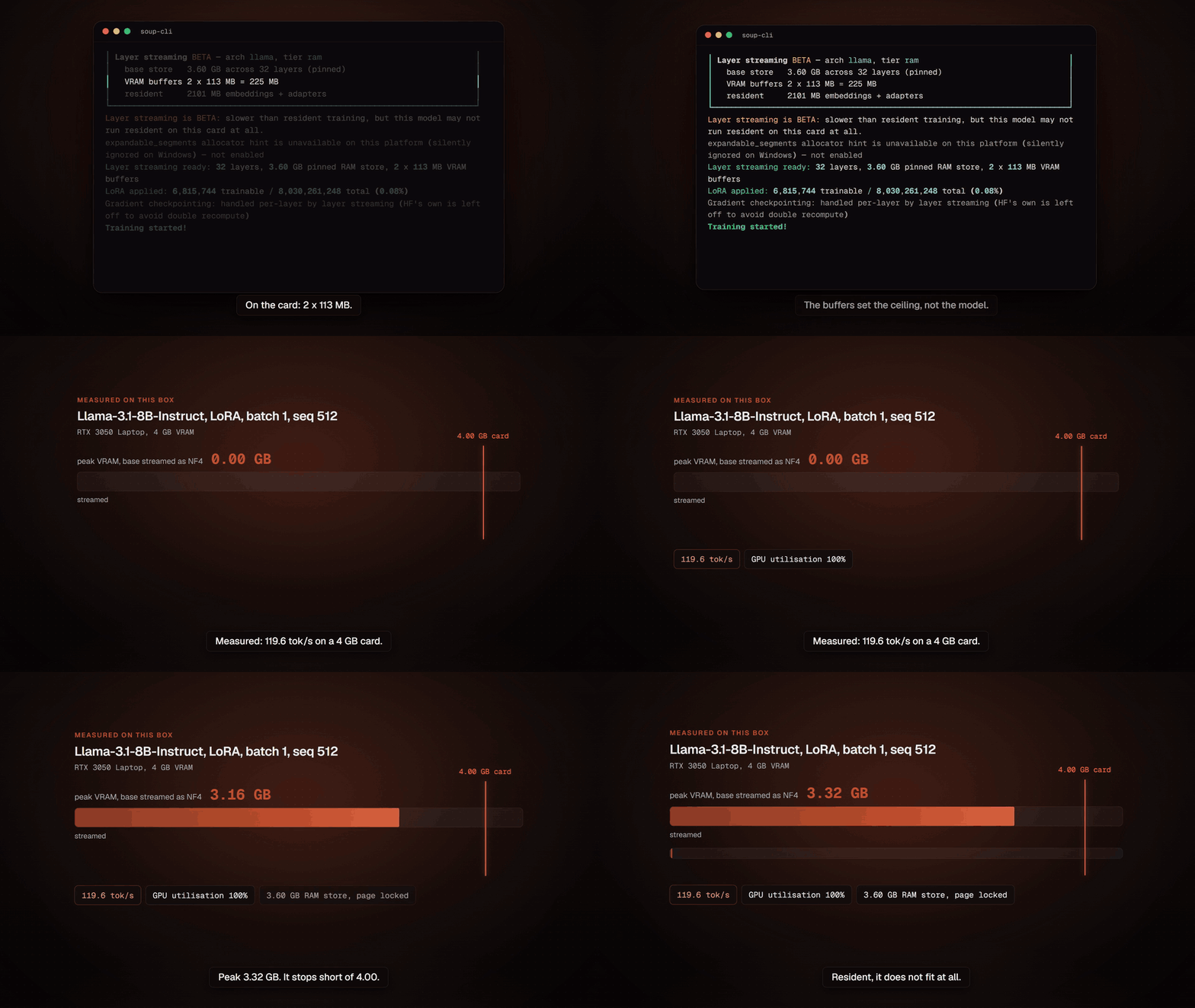
soup train pre-flight for Llama-3.1-8B on a 4 GB card: a 3.60 GB base store pinned in RAM across 32 layers and two 113 MB VRAM buffers, then a measured peak of 3.32 GB at 119.6 tok/s, stopping short of the 4 GB line (measured on v0.72.2, before the #331 repair; re-measurement pending in issue #361)
Llama-3.1-8B-Instruct + NF4, LoRA, batch 1, seq 512 on an RTX 3050 Laptop 4 GB — 3.32 GB peak, 119.6 tok/s (measured on v0.72.2, before the #331 repair; re-measurement pending in issue #361). Full video (90s)

Why Soup?

Training LLMs is still painful. Even experienced teams spend 30-50% of their time fighting infrastructure instead of improving models. Soup fixes that.

  • Zero SSH. Never SSH into a broken GPU box again.
  • One config. A simple YAML file is all you need.
  • Auto everything. Batch size, GPU detection, quantization — handled.
  • Works locally. Train on your own GPU with QLoRA. No cloud required.

What's New

v0.75.0 — the same soup.yaml trained a different recipe on MLX than on transformers, silently. Six training options were validated, documented, accepted — and read by nothing on that backend. All 60 pull requests in this release came from outside the maintainer, by 22 people.

  • Breaking: an unknown config key now refuses the load. v0.74 warned and named this release as the deadline. A typo like quantizaton, or a key that only exists on a newer Soup, used to be dropped while the run proceeded with the setting not applied; it now fails on the CLI (exit 1) and in the API (ValueError), naming the field you probably meant. The detector applies the root-level lora: remap the schema has honoured since v0.40.1, so that spelling is accepted, not refused; the two soup fetch examples files using it moved to the canonical training.lora. Every recipe and template loads clean, key names are escaped before they reach the terminal, and the scan is bounded.
  • MLX honours the config it accepted. train_on_responses_only, warmup_ratio / scheduler / weight_decay / optimizer, max_grad_norm, gradient_accumulation_steps and gradient_checkpointing were each validated and then dropped on backend: mlx. Only 8 of the 32 optimizer names have an MLX equivalent; the other 24 are refused by name instead of silently becoming AdamW. MLX also drives the live dashboard, the tracker and soup ui, and soup doctor --config lists the settings a backend does not read.
  • Validation loss existed nowhere. It was computed on every backend and thrown away: no metrics column, no event field, nothing on the panel. It is now recorded, streamed and displayed.
  • Breaking: grpo_variant: gspo is the published sequence-level objective (arXiv:2507.18071), replacing a column-centering heuristic in which a padding token also shifted the gradient of every row sharing its column. Existing gspo configs will not reproduce prior runs.
  • Web UI read endpoints and SSE require auth, with short-lived single-use tickets instead of a token in a query string; --public no longer serves /docs and /openapi.json to the LAN; and a training subprocess no longer hangs when nothing reads its output.
  • torch>=2.6.0 closes v0.74.0's known limitation: at 2.5.1 trl>=0.29 could not import and every preference trainer was dead. Also fixed: training.loraplus_lr_ratio crashed every run that set it, and packing: true raised on TRL 0.29.

Python 3.10–3.12 only. On 3.13+, pip used to resolve untested PyTorch wheels that crash in the native extension before Soup runs at all.

Older highlights live on the GitHub Releases page.

Quick Start

1. Install

Soup is a command-line application, so the cleanest install gives it its own environment and puts soup on your PATH:

# Light core: CLI + config + data tools, no PyTorch
pipx install soup-cli
uv tool install soup-cli          # same idea, if you already use uv

# Add the training stack (torch, transformers, peft, trl, datasets, …)
pipx install "soup-cli[train]"

# Everything (train + serve + ui + data) in one shot
pipx install "soup-cli[all]"

# Or from GitHub (latest dev)
pipx install "git+https://github.com/MakazhanAlpamys/Soup.git"

Already inside a virtualenv, a Colab notebook, or a Docker image? Use pip directly, with the same names and extras:

pip install soup-cli
pip install "soup-cli[train]"
pip install "soup-cli[all]"
pip install git+https://github.com/MakazhanAlpamys/Soup.git

Use pip rather than pipx if you also want to import soup_cli from your own code, since pipx deliberately isolates the application from everything else.

The full extras table (fast, mlx, serve, eval, ui, vision, audio, …) lives in docs/models.md.

error: externally-managed-environment? That is PEP 668, not a Soup problem. Debian 12, Ubuntu 23.04 and later stop pip from writing into the system Python, because apt manages those files too. pipx and uv tool sidestep it by giving Soup its own environment, which is why they are listed first above. python3 -m venv .venv && source .venv/bin/activate then plain pip works just as well.

Double quotes, not single. "soup-cli[train]" is the only spelling that works in every shell — cmd.exe, PowerShell, bash and zsh. If you copied 'soup-cli[train]' from an older tutorial and pip rejected it, that is the reason: why, and the exact error.

soup init, soup data …, and the other data/inspection commands work on the light install. Fine-tuning (soup train) needs the [train] extra.

2. Create a config

soup init                       # interactive wizard
soup init --template chat       # or start from a template

Templates: chat, code, tool-calling, medical, reasoning, vision, kto, orpo, simpo, ipo, bco, rlhf, pretrain, moe, longcontext, embedding, audio.

3. Train, test, ship

soup train --config soup.yaml                 # LoRA, quantization, batching — all handled
soup chat  --model ./output                    # talk to your model
soup push  --model ./output --repo you/my-model

soup merge  --adapter ./output                              # merge LoRA into the base
soup export --model ./output --format gguf --quant q4_k_m   # GGUF for Ollama / llama.cpp

More export targets (ONNX, TensorRT, AWQ, GPTQ, BitNet) and deployment options live in docs/serving-and-export.md.

Web UI

Prefer a browser? soup ui serves a local dashboard for experiments, training setup, live metrics, dataset exploration and model chat.

pip install "soup-cli[ui]"
soup ui
# Opens http://127.0.0.1:7860

Soup Web UI — New Training

Web UI documentation

Configuration

A complete soup.yaml:

base: meta-llama/Llama-3.1-8B-Instruct
task: sft
# backend: unsloth  # 2-5x faster, pip install "soup-cli[fast]"

data:
  train: ./data/train.jsonl
  format: alpaca
  val_split: 0.1

training:
  epochs: 3
  lr: 2e-5
  batch_size: auto
  lora:
    r: 64
    alpha: 16
  quantization: 4bit

output: ./output

config/schema.py is the single source of truth for every field. Advanced data, training, and PEFT options are documented under Documentation.

Unknown config keys are rejected since v0.75. A key no model declares — a typo like quantizaton, or a field that only exists on a newer Soup — used to validate clean and be discarded, so the run proceeded with the setting simply not applied. v0.74 reported it at load with the field you probably meant; from v0.75 the same config fails to load, so fix or remove the key rather than relying on it being ignored. See Unknown config keys.

Documentation

The full feature reference lives in docs/. Start here:

Guide Covers
Training tasks & methods SFT, DPO/GRPO/PPO/KTO/ORPO/SimPO/IPO/BCO, tool-calling, PRM, pre-training, distillation, classification, vision/audio/TTS, unlearning, RAFT/RA-DIT, loop-hardening detectors
PEFT, long context & efficiency DoRA, LoRA+, rsLoRA, VeRA, OLoRA, NEFTune, PiSSA, ReLoRA, optimizer & PEFT zoo, LLaMA Pro, GaLore, YaRN/LongLoRA, packing, curriculum, auto-tuning
Performance & quantization QAT, FP8, Quant Menu (I + II), KV-cache, NVFP4, save formats, Cut Cross-Entropy, gradient checkpointing, kernels, activation offloading, layer streaming, multi-GPU / DeepSpeed / FSDP
Data engineering Formats, the Axolotl/LF-parity pipeline, data tools, synthetic generation & forge, quality scorecards, trace tooling, remote datasets, mixing, recipe DAGs
Evaluation & probes Eval design/gate, eval-gated training, benchmarks, NLG metrics, calibration, Elo arena, diagnose, post-train X-ray probes, A/B, drift, tunability, soup advise
Serving & export OpenAI-compatible server, batch inference, benchmarking, merge/export, Anthropic Messages endpoint, speculative decoding (train + measure your own draft), deploy autopilot, Web UI, Agent Forge
Adapters, registry & governance Adapter lifecycle/management, model registry, Soup Cans, the data flywheel (soup loop), knowledge editing, steering, supply-chain controls (scan/sign/BOM/attest/audit/airgap)
Compliance & governance quickstart HIPAA/SOC2/EU-AI-Act/SR-11-7 init templates, provenance (BOM/attest/repro-receipt), audit log, air-gap, model-card autogen (soup card), CI gate (soup ci init)
Backends, platform & ops MLX/Unsloth backends, alternative hubs, HF Hub integration, autopilot, experiment tracking, plan/apply, env lockfiles, hardware-fit, completions, plugins, utility commands
Command reference The full soup command list
Supported models & extras Recommended model families, the VRAM size guide, the pip extras matrix

Data Formats

Alpaca, ShareGPT, ChatML, preference pairs (DPO / ORPO / SimPO / IPO / KTO), vision, audio, ASR, plaintext, embedding, RAFT and more — all auto-detected from JSONL, JSON, CSV, Parquet or TXT, so in most cases you point data.train at a file and nothing else changes. Schemas with a worked example per format, plus the data pipeline (remote URIs, streaming, sharding, interleaving, vocab expansion, document ingestion), are in docs/data.md.

Common Commands

soup train  --config soup.yaml        # train (SFT/DPO/GRPO/PPO/KTO/ORPO/SimPO/IPO/...)
soup infer  --model ./output --input prompts.jsonl   # batch inference
soup chat   --model ./output          # interactive chat
soup serve  --model ./output          # OpenAI-compatible API server
soup ui                               # local browser dashboard
soup merge  --adapter ./output        # merge LoRA into the base model
soup export --model ./output --format gguf           # export for deployment
soup eval   benchmark --model ./output               # evaluate
soup data   inspect ./data/train.jsonl               # dataset stats
soup recipes list                     # 100+ ready-made model recipes
soup autopilot --model <id> --data d.jsonl --goal chat  # zero-config
soup doctor                           # check GPU / deps / environment

The complete command list is in docs/commands.md.

Supported Models

Soup works with any text-generation model on the HuggingFace Hub — if it loads with AutoModelForCausalLM, it works, zero config changes. Llama 3.x/4, Qwen 2.5/3, Gemma 3, Mistral, Mixtral, DeepSeek R1/V3, Phi-4, and 100+ others ship as ready-made recipes (soup recipes list).

VRAM Max model (QLoRA 4-bit) Example
8 GB ~7B Llama-3.1-8B, Mistral-7B
16 GB ~14B Phi-4-14B, Qwen2.5-14B
24 GB ~34B CodeLlama-34B, Yi-1.5-34B
48 GB ~70B Llama-3.3-70B
80 GB+ 70B+ (full) or MoE Mixtral-8x22B, DeepSeek-V3

Full model + vision tables and the optional-extras matrix are in docs/models.md.

Docker

Run Soup without installing CUDA or PyTorch locally (image published to GHCR on every release):

docker pull ghcr.io/makazhanalpamys/soup:latest
docker run --gpus all -v $(pwd):/workspace ghcr.io/makazhanalpamys/soup train --config soup.yaml
docker compose up   # or build locally

Requirements

  • Python 3.10, 3.11 or 3.12 (those are the versions CI tests; 3.13+ is not supported yet because the PyTorch stack has not been validated there)
  • GPU with CUDA (recommended), Apple Silicon (MPS), or CPU (experimental — very slow)
  • 8 GB+ VRAM for 7B models with QLoRA

All training tasks run on CPU for testing (quantization auto-disabled). Optional extras (train, all, fast, vision, qat, serve, serve-fast, ui, eval, deepspeed, liger, mlx, onnx, tensorrt, …) are listed in docs/models.md.

Troubleshooting

soup doctor    # GPU, system resources, dependencies, and version in one place

CUDA wheels, version mismatches: docs/backends-and-ops.md.

Development

git clone https://github.com/MakazhanAlpamys/Soup.git
cd Soup
pip install -e ".[dev]"

ruff check src/soup_cli/ tests/    # lint
pytest tests/ -v                   # unit tests (fast, no GPU)
pytest tests/ -m smoke -v          # smoke tests (downloads a tiny model, trains)
pytest tests/ -m gpu --no-cov -v   # GPU tests (need a CUDA card; report results, see CONTRIBUTING.md)

pre-commit install                 # optional: ruff lint+format on commit

See CONTRIBUTING.md for the full workflow and SECURITY.md to report a vulnerability. Telemetry is strictly opt-in (SOUP_TELEMETRY=1, default off; see Privacy Policy).

Support Soup

Soup is Apache-2.0 and free — and stays that way. It is built and maintained in the open on a single 4 GB laptop, which is why every performance number in these docs is measured rather than claimed.

If Soup saved you a training run, starring the repo helps most, and it costs nothing. If you would like to fund the work directly:

❤️ Donate — one-off, any amount (use Change amount on the checkout page). Payments are processed by Stripe under the maintainer's registered business, MePlay, Inc. — that name, not "Soup", is what appears on the checkout page and on your card statement.

Donations buy GPU time for the hardware-gated work — multi-GPU, 8B+ validation, Apple Silicon — that a single 4 GB laptop cannot reach.

The other way to move exactly those items is hardware itself. They ship behind honest "requires <hardware>" gates rather than unverified claims, so if you have access to a bigger box — or GPU credits going unused — running one of the help wanted issues and posting the numbers helps as much as funding the GPU time would. Those issues say exactly what is blocked on hardware today.

Contributors

Built by the community ❤️ — thank you to everyone who has contributed. See CONTRIBUTORS.md.

Contributors

Contact

Bugs and feature requests belong in the issue tracker, questions in Discussions — both get answered faster and help the next person with the same problem.

For live chat, setup help, and everything that reads better as a conversation, join the Discord or the Telegram community. Anything that should still be findable in six months belongs in Issues or Discussions — a Discord answer helps one person, an issue helps everyone who hits the same thing. The Code of Conduct applies there too.

For anything that does not fit in public — security reports (see SECURITY.md), Code of Conduct matters, or press — email team@trysoup.dev. That is the project address and the right one for anything Soup-related. makazanalpamys@gmail.com is the maintainer's personal address; it reaches the same person and is a fine fallback.

Citing Soup

Layer streaming — training an 8B model on a 4 GB laptop GPU by streaming the frozen base from host RAM one decoder layer at a time — is described in a preprint, together with the correctness protocol that verifies a streamed run against a resident one (forward and backward stated separately, because they are two claims and not one).

Makazhan, A. (2026). Exact Layer Streaming: LoRA Fine-Tuning of an 8B Model on a 4 GB Laptop GPU (v3). Zenodo. https://doi.org/10.5281/zenodo.21918325

Version 3 (13 August 2026) is current. The title and the claim are unchanged — 8B on 4 GB — and no measured number has changed since v1. What v3 does is withdraw an explanation we had published, which is also the shortest way to describe what the paper is for:

  • Retracted in v3: "layer streaming is bound by host-to-device transfer, not by the GPU." That was an inference from the H100 replication below, and it had never been measured. We measured it on 11 August and it is false at the published configuration: deleting every host-to-device byte buys 1.4%, the compute stream waits on a copy for 0.20% of the step, and the step runs at 71.3% of that card's same-session GEMM ceiling. The largest streaming-specific cost is the per-layer NF4 dequantisation, at 9.8% (the record). Every measurement stands; the replication survives in a weaker form — the constraint is common to both machines and is not the GPU's compute.
  • Replication on hardware nothing like the original (added in v2): 119.6 tok/s on the RTX 3050 against a median 113.00 on an H100, at the same 3.32 GB peak. Both pre-date the #331 repair; the 4 GB re-measurement is pending in issue #361.
  • A silent wrong-gradient defect, found and repaired. On NF4 above ~165 MiB per layer the forward stayed bit-exact and the loss curve looked healthy while the gradients were wrong. The cause is named in the upstream library and reported there; the repair is gated against controls on real 32B and 72B.
  • Bit-exactness at real model sizes instead of three-layer toys: forward from 0.5B to 72B, backward at 8B and 14B.
  • Trained-model quality, measured for the first time, and indistinguishable from a resident run.
  • A comparison against DeepSpeed — including the result that does not flatter us: eight cards of ZeRO-3 are slower than one card training resident.
  • The limitations section rewritten: of v1's ten items, one closed and four more narrowed, and seven new ones added.

Cite the version you used. 10.5281/zenodo.21771064 is the concept DOI and always resolves to the latest version (v3 today); v1 and v2 remain citable at their own version DOIs and are not edited — the retraction above is a new version precisely so that the record of what we claimed, and when, stays intact.

The measurement records behind every number in it are in benchmarks/, published as written — including the failures, the assumptions that turned out wrong, and the numbers that were measured and then discarded.

@misc{makazhan2026exact,
  title        = {Exact Layer Streaming: LoRA Fine-Tuning of an 8B Model on a 4 GB Laptop GPU},
  author       = {Makazhan, Alpamys},
  year         = {2026},
  publisher    = {Zenodo},
  version      = {v3},
  doi          = {10.5281/zenodo.21918325},
  url          = {https://doi.org/10.5281/zenodo.21918325}
}

License

Apache-2.0. Copyright © the Soup contributors.

View on GitHub

Recent activity

commits and pull requests

Releases and announcements

179 total
  1. A security patch release for the 0.75 line. It carries one hardening change and nothing else; everything merged on `main` since 0.75.0 ships in the next minor release. ## What's New - **Outbound endpoint checks refuse private IP literals on every scheme.** `soup data generate --api-base`, the vLLM provider and the commands that use it, judge URLs in `soup eval judge`, eval-gate suites, `soup ship --judge-model` / `eval.ship.judge_model`, `training.online_dpo_judge`, and the Web UI chat proxy now refuse a private, link-local or reserved IP literal over `https` as well as `http`. Loopback still works; address a server on your network by its hostname. `training.online_dpo_judge` is checked when soup.yaml loads, not only when the trainer starts. - **`http://0.0.0.0` is no longer treated as local** by `soup data generate --api-base` and the Web UI chat proxy; use `localhost` or `127.0.0.1`. - **`100.64.0.0/10` and `fec0::/10` are non-public** for every check that already refused private addresses (webhooks, the OTLP endpoint, telemetry, hub endpoints over HTTP, and `soup ingest --pull`, where `--allow-private-host` admits them). - **Non-ASCII spellings of an address are classified as

  2. **v0.75.1 is a backport, not a cut of `main`.** Its tree is tag `v0.75.0` plus 25 cherry-picks, one test adaptation and the release commits. `main` was 186 commits past `v0.75.0` when this release was cut, so releasing from `main` would have shipped an entire minor's worth of unreleased work under a patch number. The diff of `v0.75.0...v0.75.1` is exactly what these notes describe. ## What's New - **A layer-streamed LoRA adapter saved as ZERO tensors under peft 0.21.0** (#1005, fixed in #1010). peft 0.21 selects an adapter's tensors by the prefixes it reads off `model.named_modules()`, where 0.20 filtered by the `lora_` substring. The streaming wrapper's module and parameter names carried `.inner.` while its `state_dict()` keys were canonical, so `trainer.save_model()`, every `save_steps` checkpoint and `get_peft_model_state_dict()` returned nothing — and nothing raised. **Any adapter saved with `stream_layers: true` on peft>=0.21 before this fix holds zero tensors (a 40-byte `adapter_model.safetensors`) and cannot be recovered: re-train it.** Naming only; nothing on the streamed forward path changes. - **`soup runs clean --keep-weights` did the opp

  3. **All 60 pull requests in this release came from outside the maintainer**, by 22 people. What they found is the release: on the MLX backend, six training options were validated, documented, accepted — and read by nothing, so the same `soup.yaml` trained a different recipe on Apple Silicon than on a CUDA box, silently. And the deadline v0.74.0 promised is honoured: an unknown config key now refuses the load. ## What's New - **Breaking: an unknown config key refuses the load.** v0.74.0 reported every key no config model declares — a typo like `quantizaton`, or a field that only exists on a newer Soup — as a warning that named v0.75 as the release that would start refusing. This is that release: `soup train` exits 1 before the training stack is imported, and the API / Web UI loader raises `ValueError` with the same text, naming the field you probably meant. Nothing is defaulted or substituted. The refusal says `Refused.` rather than `Not applied.`; the `soup sweep` guard, which always refused, changes wording the same way. The detector sees a config the way `SoupConfig` does: a root-level `lora:` block (the LlamaFactory / Axolotl spelling the schema has accepted and moved under `tra

  4. **116 of the 120 merged pull requests in this release came from outside the maintainer, by 25 people.** The maintainer's own four were #484, #486, #498 and #509. ## What's New **The frozen base was being loaded in fp32 the whole time (#339 by @blackcoderx in #471).** All three `from_pretrained` sites — text, vision, audio — passed no explicit dtype, so a base that never receives an optimizer step was materialised at twice its checkpoint precision. Measured on an H100 with Llama-3.1-8B + LoRA: **48,241 MiB -> 18,658 MiB peak, 2.59x / 28.9 GB**, byte-identical across three repeats. A *trainable* base still loads fp32, deliberately and documented. The full-fine-tune discriminator is now one shared `is_full_finetune()` used by both the trainer and the VRAM pre-flight — previously two independent copies that disagreed in both directions. **Transformers 5.x, TRL 0.29, PEFT 0.20 (#502/#503 by @Amix29 in #507).** Qwen3.5-family text decoders train on the Transformers path, TRL APIs that moved under `trl.experimental` are reached by capability probe rather than a version table, and `pip install "soup-cli[train,mlx]"` resolves again — the two extras previously declared ranges that could n

  5. **Every one of the 24 pull requests in this release came from someone other than the maintainer** — from eight people, five of whom appear here for the first time. The maintainer's own work in this window arrived as four direct commits (license headers, a test repair, a CI guard), not as pull requests. What they found is the more interesting number: **four separate config flags that were validated by the schema, documented, and then read by nothing.** ## What's New **Four flags that did nothing** - **`training.bnb_4bit_use_double_quant` was read by nothing.** Every 4-bit construction site hardcoded `use_double_quant=True`, so setting it to `false` changed your config fingerprint and nothing else. The fix's design choice is the interesting half: the field is `Optional[bool] = None`, not a plain `True`, because a `True` default emits the key into `model_dump()` and trips the footgun guard on re-validation — measured, **21 of 173 shipped configs** stopped round-tripping, which would have broken `train --replay` and `soup sweep`. (#321) - **On Apple Silicon, `quantization: 4bit` was silently rewritten to `none`.** `detect_device()` did not know MLX, so every run reported "CPU (no G

Code frequency

additions and deletions
+154.4K-154.4KWeek of 2026-02-15: +2,003 linesWeek of 2026-02-15: -33 linesWeek of 2026-02-22: +3,111 linesWeek of 2026-02-22: -67 linesWeek of 2026-03-01: +6,394 linesWeek of 2026-03-01: -295 linesWeek of 2026-03-08: +0 linesWeek of 2026-03-08: -0 linesWeek of 2026-03-15: +0 linesWeek of 2026-03-15: -0 linesWeek of 2026-03-22: +28,037 linesWeek of 2026-03-22: -2,078 linesWeek of 2026-03-29: +17,744 linesWeek of 2026-03-29: -492 linesWeek of 2026-04-05: +3,027 linesWeek of 2026-04-05: -220 linesWeek of 2026-04-12: +5,716 linesWeek of 2026-04-12: -83 linesWeek of 2026-04-19: +16,951 linesWeek of 2026-04-19: -1,069 linesWeek of 2026-04-26: +21,176 linesWeek of 2026-04-26: -590 linesWeek of 2026-05-03: +6,917 linesWeek of 2026-05-03: -662 linesWeek of 2026-05-10: +71,672 linesWeek of 2026-05-10: -1,224 linesWeek of 2026-05-17: +37,223 linesWeek of 2026-05-17: -273 linesWeek of 2026-05-24: +21,230 linesWeek of 2026-05-24: -183 linesWeek of 2026-05-31: +154,401 linesWeek of 2026-05-31: -116,255 linesWeek of 2026-06-07: +17,995 linesWeek of 2026-06-07: -824 linesWeek of 2026-06-14: +112 linesWeek of 2026-06-14: -10 linesWeek of 2026-06-21: +3,179 linesWeek of 2026-06-21: -49 linesWeek of 2026-06-28: +14,328 linesWeek of 2026-06-28: -530 linesWeek of 2026-07-05: +12,267 linesWeek of 2026-07-05: -2,143 linesWeek of 2026-07-12: +15,015 linesWeek of 2026-07-12: -867 linesWeek of 2026-07-19: +5,946 linesWeek of 2026-07-19: -161 linesWeek of 2026-07-26: +11,707 linesWeek of 2026-07-26: -417 linesWeek of 2026-08-02: +15,488 linesWeek of 2026-08-02: -1,914 linesWeek of 2026-08-09: +14,582 linesWeek of 2026-08-09: -1,534 linesWeek of 2026-08-16: +17,666 linesWeek of 2026-08-16: -1,376 linesWeek of 2026-08-23: +20,573 linesWeek of 2026-08-23: -1,380 linesWeek of 2026-08-30: +76,637 linesWeek of 2026-08-30: -51,637 linesWeek of 2026-09-06: +22,822 linesWeek of 2026-09-06: -1,570 linesWeek of 2026-09-13: +123,637 linesWeek of 2026-09-13: -4,403 linesWeek of 2026-09-20: +47,515 linesWeek of 2026-09-20: -3,039 linesWeek of 2026-09-27: +101,477 linesWeek of 2026-09-27: -5,418 linesWeek of 2026-10-04: +0 linesWeek of 2026-10-04: -0 linesFeb 15, 2026Oct 4, 2026
+916.5K lines added, -200.8K removed over the last year.

Commits per week

last 52 weeks
1830Week of 2025-10-04: 0 commitsWeek of 2025-10-11: 0 commitsWeek of 2025-10-18: 0 commitsWeek of 2025-10-25: 0 commitsWeek of 2025-11-01: 0 commitsWeek of 2025-11-09: 0 commitsWeek of 2025-11-16: 0 commitsWeek of 2025-11-23: 0 commitsWeek of 2025-11-30: 0 commitsWeek of 2025-12-07: 0 commitsWeek of 2025-12-14: 0 commitsWeek of 2025-12-21: 0 commitsWeek of 2025-12-28: 0 commitsWeek of 2026-01-04: 0 commitsWeek of 2026-01-11: 0 commitsWeek of 2026-01-18: 0 commitsWeek of 2026-01-25: 0 commitsWeek of 2026-02-01: 0 commitsWeek of 2026-02-08: 0 commitsWeek of 2026-02-15: 5 commitsWeek of 2026-02-22: 4 commitsWeek of 2026-03-01: 20 commitsWeek of 2026-03-08: 0 commitsWeek of 2026-03-15: 0 commitsWeek of 2026-03-22: 95 commitsWeek of 2026-03-29: 40 commitsWeek of 2026-04-05: 11 commitsWeek of 2026-04-12: 7 commitsWeek of 2026-04-19: 23 commitsWeek of 2026-04-26: 27 commitsWeek of 2026-05-03: 18 commitsWeek of 2026-05-10: 54 commitsWeek of 2026-05-17: 20 commitsWeek of 2026-05-24: 13 commitsWeek of 2026-05-31: 44 commitsWeek of 2026-06-07: 18 commitsWeek of 2026-06-14: 3 commitsWeek of 2026-06-21: 5 commitsWeek of 2026-06-28: 36 commitsWeek of 2026-07-05: 65 commitsWeek of 2026-07-12: 56 commitsWeek of 2026-07-19: 8 commitsWeek of 2026-07-26: 20 commitsWeek of 2026-08-02: 111 commitsWeek of 2026-08-09: 78 commitsWeek of 2026-08-16: 95 commitsWeek of 2026-08-23: 101 commitsWeek of 2026-08-30: 113 commitsWeek of 2026-09-06: 101 commitsWeek of 2026-09-13: 183 commitsWeek of 2026-09-20: 100 commitsWeek of 2026-09-27: 159 commitsOct 4, 2025Sep 27, 2026
1.6K commits in the last 52 weeks.

When work happens

weekday and hour
SunMonTueWedThuFriSat036912151821Sun 0:00 — 3 commitsSun 1:00 — 0 commitsSun 2:00 — 1 commitsSun 3:00 — 2 commitsSun 4:00 — 2 commitsSun 5:00 — 1 commitsSun 6:00 — 2 commitsSun 7:00 — 0 commitsSun 8:00 — 2 commitsSun 9:00 — 3 commitsSun 10:00 — 11 commitsSun 11:00 — 8 commitsSun 12:00 — 11 commitsSun 13:00 — 19 commitsSun 14:00 — 20 commitsSun 15:00 — 25 commitsSun 16:00 — 27 commitsSun 17:00 — 20 commitsSun 18:00 — 7 commitsSun 19:00 — 21 commitsSun 20:00 — 17 commitsSun 21:00 — 20 commitsSun 22:00 — 10 commitsSun 23:00 — 5 commitsMon 0:00 — 4 commitsMon 1:00 — 3 commitsMon 2:00 — 0 commitsMon 3:00 — 0 commitsMon 4:00 — 0 commitsMon 5:00 — 4 commitsMon 6:00 — 1 commitsMon 7:00 — 4 commitsMon 8:00 — 8 commitsMon 9:00 — 8 commitsMon 10:00 — 12 commitsMon 11:00 — 10 commitsMon 12:00 — 13 commitsMon 13:00 — 17 commitsMon 14:00 — 10 commitsMon 15:00 — 10 commitsMon 16:00 — 23 commitsMon 17:00 — 12 commitsMon 18:00 — 21 commitsMon 19:00 — 24 commitsMon 20:00 — 36 commitsMon 21:00 — 31 commitsMon 22:00 — 21 commitsMon 23:00 — 22 commitsTue 0:00 — 6 commitsTue 1:00 — 2 commitsTue 2:00 — 2 commitsTue 3:00 — 0 commitsTue 4:00 — 1 commitsTue 5:00 — 0 commitsTue 6:00 — 1 commitsTue 7:00 — 2 commitsTue 8:00 — 6 commitsTue 9:00 — 4 commitsTue 10:00 — 4 commitsTue 11:00 — 16 commitsTue 12:00 — 35 commitsTue 13:00 — 19 commitsTue 14:00 — 11 commitsTue 15:00 — 19 commitsTue 16:00 — 13 commitsTue 17:00 — 8 commitsTue 18:00 — 11 commitsTue 19:00 — 9 commitsTue 20:00 — 4 commitsTue 21:00 — 6 commitsTue 22:00 — 16 commitsTue 23:00 — 14 commitsWed 0:00 — 20 commitsWed 1:00 — 4 commitsWed 2:00 — 11 commitsWed 3:00 — 2 commitsWed 4:00 — 0 commitsWed 5:00 — 1 commitsWed 6:00 — 1 commitsWed 7:00 — 3 commitsWed 8:00 — 1 commitsWed 9:00 — 2 commitsWed 10:00 — 3 commitsWed 11:00 — 3 commitsWed 12:00 — 22 commitsWed 13:00 — 16 commitsWed 14:00 — 15 commitsWed 15:00 — 20 commitsWed 16:00 — 17 commitsWed 17:00 — 16 commitsWed 18:00 — 25 commitsWed 19:00 — 8 commitsWed 20:00 — 7 commitsWed 21:00 — 11 commitsWed 22:00 — 14 commitsWed 23:00 — 15 commitsThu 0:00 — 8 commitsThu 1:00 — 2 commitsThu 2:00 — 1 commitsThu 3:00 — 2 commitsThu 4:00 — 2 commitsThu 5:00 — 1 commitsThu 6:00 — 0 commitsThu 7:00 — 3 commitsThu 8:00 — 1 commitsThu 9:00 — 1 commitsThu 10:00 — 9 commitsThu 11:00 — 3 commitsThu 12:00 — 14 commitsThu 13:00 — 18 commitsThu 14:00 — 18 commitsThu 15:00 — 16 commitsThu 16:00 — 30 commitsThu 17:00 — 32 commitsThu 18:00 — 19 commitsThu 19:00 — 23 commitsThu 20:00 — 12 commitsThu 21:00 — 14 commitsThu 22:00 — 19 commitsThu 23:00 — 20 commitsFri 0:00 — 9 commitsFri 1:00 — 3 commitsFri 2:00 — 2 commitsFri 3:00 — 1 commitsFri 4:00 — 1 commitsFri 5:00 — 0 commitsFri 6:00 — 0 commitsFri 7:00 — 2 commitsFri 8:00 — 4 commitsFri 9:00 — 6 commitsFri 10:00 — 2 commitsFri 11:00 — 16 commitsFri 12:00 — 15 commitsFri 13:00 — 11 commitsFri 14:00 — 13 commitsFri 15:00 — 7 commitsFri 16:00 — 18 commitsFri 17:00 — 8 commitsFri 18:00 — 16 commitsFri 19:00 — 26 commitsFri 20:00 — 9 commitsFri 21:00 — 12 commitsFri 22:00 — 21 commitsFri 23:00 — 20 commitsSat 0:00 — 7 commitsSat 1:00 — 9 commitsSat 2:00 — 0 commitsSat 3:00 — 0 commitsSat 4:00 — 0 commitsSat 5:00 — 0 commitsSat 6:00 — 0 commitsSat 7:00 — 0 commitsSat 8:00 — 4 commitsSat 9:00 — 3 commitsSat 10:00 — 1 commitsSat 11:00 — 3 commitsSat 12:00 — 13 commitsSat 13:00 — 10 commitsSat 14:00 — 17 commitsSat 15:00 — 8 commitsSat 16:00 — 11 commitsSat 17:00 — 8 commitsSat 18:00 — 8 commitsSat 19:00 — 17 commitsSat 20:00 — 12 commitsSat 21:00 — 13 commitsSat 22:00 — 14 commitsSat 23:00 — 11 commits
Commit volume by weekday and hour (UTC). Larger dots mean more commits.

Who is committing

last 52 weeks
Maintainer commits1,097 (67%)
Community commits541 (33%)

1,638 commits in total over the last year.

DateListRankStars gained
Sep 28, 2026monthly#20+4,232
Sep 27, 2026monthly#20+4,232
Sep 26, 2026monthly#20+4,225
Sep 6, 2026weekly#15+1,808
Sep 5, 2026weekly#15+1,808
Sep 4, 2026weekly#15+1,812
Aug 17, 2026daily#6+297
Aug 16, 2026daily#6+297
  • public-apis/public-apis

    A collective list of free APIs

    486.1K stars · Python

  • donnemartin/system-design-primer

    Learn how to design large-scale systems. Prep for the system design interview. Includes Anki flashcards.

    373.2K stars · Python

  • practical-tutorials/project-based-learning

    Curated list of project-based tutorials

    285.8K stars · Python

  • affaan-m/ECC

    The agent harness performance optimization system. Skills, instincts, memory, security, and research-first development for Claude Code, Codex, Opencode, Cursor and beyond.

    272.8K stars · JavaScript

  • NousResearch/hermes-agent

    The agent that grows with you

    251.2K stars · Python

  • n8n-io/n8n

    Fair-code workflow automation platform with native AI capabilities. Combine visual building with custom code, self-host or cloud, 400+ integrations.

    206.7K stars · TypeScript